Is Homeopathy Regulated? A Guide for Skeptical US Patients
If you’re American and considering homeopathy for the first time, one of the most reasonable questions you can ask is:
“Is this actually regulated?”
Many people assume that if a healthcare service exists, it must be licensed by the state in the same way physicians, nurses, dentists, or pharmacists are. When they discover that homeopathy doesn’t fit neatly into that system in the United States, it naturally raises more questions.
This article explains what regulation really means, what the legal landscape looks like in the U.S., what credentials homeopathic practitioners may hold, and how you can evaluate a practitioner for yourself.
What Does “Regulated” Usually Mean?
In American healthcare, the word regulated can refer to several different things.
One is government regulation of products. Prescription drugs and many over-the-counter medicines are reviewed by the U.S. Food and Drug Administration (FDA) before being marketed. Healthcare products may also be subject to manufacturing and labeling requirements.
Another is professional licensing. Physicians, nurses, psychologists, physical therapists, and many other healthcare professionals obtain state-issued licenses that legally authorize them to practice within defined scopes of care.
Homeopathy doesn’t fit perfectly into either category.
Homeopathic medicines sold in the United States are regulated by the FDA as drug products under the Federal Food, Drug, and Cosmetic Act, although they do not undergo the same pre-market approval process required for new conventional prescription drugs. In recent years, the FDA has adopted a risk-based enforcement approach, focusing its oversight on homeopathic products that may pose greater public health risks rather than reviewing every product individually.
The situation for practitioners is different.
Unlike physicians or registered nurses, there is no nationwide state licensing system specifically for homeopathic practitioners in the United States. In most states, there is no dedicated state board that licenses someone simply as a “homeopath.”
That surprises many people, but it’s important to understand what it does and doesn’t mean.
It does not automatically mean that homeopathy is illegal. Nor does it mean that anyone can claim any qualification they like without scrutiny.
Instead, the legal picture depends largely on state law.
The Legal Landscape: Mostly Unregulated, Not Prohibited
A common misconception is that homeopathy exists in a legal gray area across the United States. The reality is more nuanced. Most states do not have specific licensing laws for homeopathic practitioners. Only three states, Arizona, Connecticut, and Nevada, have dedicated licensing pathways for homeopathic practice. Arizona has the broadest system, licensing both homeopathic physicians and certain qualified homeopathic practitioners. Connecticut and Nevada limit homeopathic licensure to physicians (MDs or DOs) who complete additional homeopathic training. In the remaining states, there is generally no separate homeopathy license. Instead, homeopathy may be practiced under Health Freedom laws, within another licensed profession’s scope of practice, or in states that are simply silent on homeopathic practice.
Some states have gone further by passing Health Freedom laws that explicitly recognize consumers’ ability to seek complementary and alternative healthcare services.
Examples include:
- California – Health Freedom Act (California Senate Bill 577), which allows certain complementary and alternative healthcare practitioners to provide services without holding a medical license, provided they meet disclosure requirements and do not perform acts reserved for licensed medical professionals.
- Minnesota – Complementary and Alternative Health Care Practices Act, which establishes disclosure requirements, consumer rights, and complaint procedures for unlicensed complementary healthcare practitioners.
- Oklahoma – Health Freedom Act, which similarly protects access to certain complementary healthcare practices under specified conditions.
These laws do not create a government-issued license for homeopaths. Instead, they generally require transparency, informed consent, and truthful disclosure while helping clarify that consumers may choose complementary healthcare providers if they wish. In states without Health Freedom legislation, practitioners must still comply with applicable state laws governing healthcare practice, advertising, fraud, and consumer protection.
For patients, the practical takeaway is simple: In most of the United States, homeopathy is neither broadly licensed nor broadly prohibited. Instead, practitioners operate within general legal frameworks and, where applicable, state-specific health freedom laws.
What Credentials Do Homeopathic Practitioners Have?
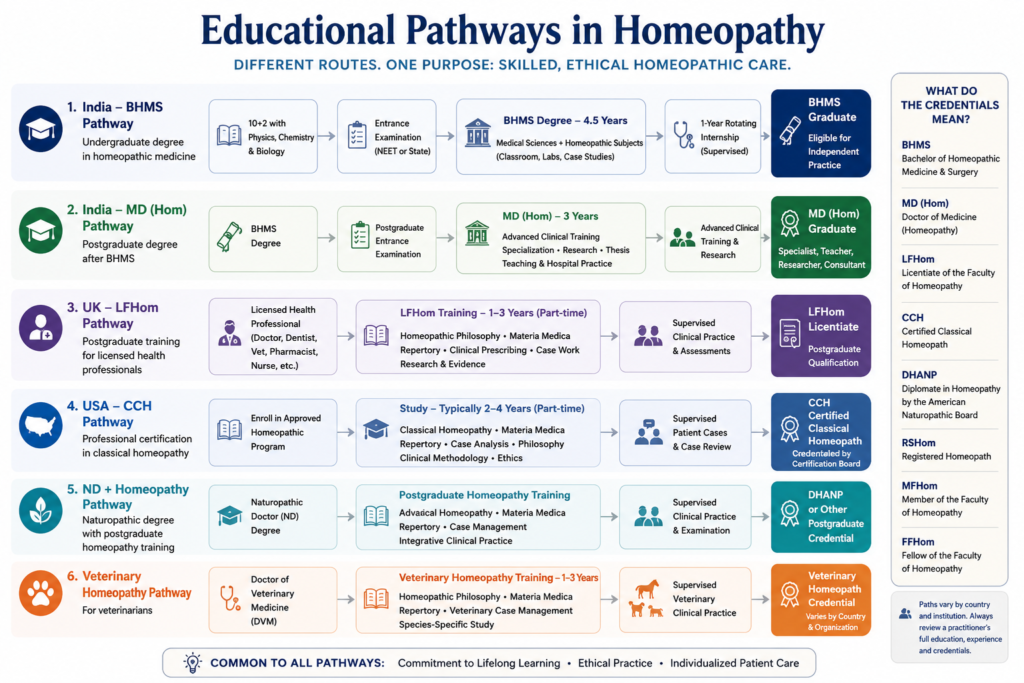
Since there is no universal U.S. licensing pathway, credentials become especially important. Not every practitioner has the same educational background, and understanding the letters after someone’s name can help you make a more informed decision.
BHMS (Bachelor of Homeopathic Medicine and Surgery)
Many practitioners serving international patients, including many listed on HomeoPath, earned a BHMS degree. The BHMS is a professional medical degree awarded by recognized universities in India. It is regulated under India’s National Commission for Homoeopathy (NCH), which operates under the Ministry of AYUSH, Government of India.
A BHMS program typically involves approximately 5½ years of education, including classroom study and a compulsory clinical internship. This degree is officially recognized by the Indian government. However, it’s important to understand that holding a BHMS does not automatically grant a medical license to practice medicine in the United States. Practitioners must comply with U.S. state laws regardless of where they trained.
R.Hom and Professional Certifications
Some practitioners also hold professional certifications such as R.Hom (Registered Homeopath) through organizations like the North American Society of Homeopaths (NASH). These certifications are professional credentials, not government-issued licenses.
Certification generally indicates that a practitioner has completed specified education, clinical training, case reviews, continuing education, and adherence to an ethical code established by the certifying organization. Different organizations have different requirements, so it’s worth checking what a particular credential represents.
Licensed Healthcare Professionals Who Also Practice Homeopathy
Some homeopathic practitioners are also licensed physicians, naturopathic doctors (where licensed), nurse practitioners, chiropractors, dentists, or other healthcare professionals. In these cases, their underlying professional license comes from their state’s licensing board, while homeopathy represents an additional area of training or practice.
How to Vet a Homeopathic Practitioner Yourself
Whether you’re exploring homeopathy or any complementary healthcare service, asking questions is a good idea.
Here are a few practical things to look for:
1. What formal education have they completed?
Ask where they studied, how long the program lasted, and whether they completed supervised clinical training.
2. What credentials do they hold?
Look for clearly explained qualifications such as BHMS, R.Hom, or other recognized certifications. A trustworthy practitioner should explain what those credentials mean not simply list abbreviations.
3. Are they transparent about their legal status?
If they are not a state-licensed physician or other licensed healthcare professional, they should clearly disclose that fact where required by law. Transparency is a positive sign.
4. Do they explain their approach honestly?
Be cautious of practitioners who promise guaranteed outcomes or claim to cure diseases. Responsible practitioners should discuss their services realistically and avoid exaggerated claims.
5. Are they willing to answer questions?
You should feel comfortable asking about training, experience, consultation style, fees, and professional background before booking an appointment. A reputable practitioner shouldn’t hesitate to answer these questions.
How HomeoPath Approaches Practitioner Credentials
At HomeoPath, we believe transparency builds trust better than marketing ever can.
Rather than implying government licensure where none exists, we clearly identify practitioners’ qualifications and professional backgrounds so patients can make informed decisions. Where applicable, practitioner profiles include information such as:
- Educational qualifications (including BHMS where relevant)
- Professional certifications
- Country of training
- Areas of clinical interest
We encourage every patient to review a practitioner’s credentials, ask questions, and choose someone whose background gives them confidence. You can browse our Practitioner Directory to compare practitioner profiles before deciding whether to book a consultation.
The Bottom Line
Homeopathy occupies a different regulatory space than conventional medicine in the United States. There is no nationwide licensing board for homeopathic practitioners, and most states do not issue a dedicated homeopathy license. Some states have enacted Health Freedom laws that explicitly recognize complementary healthcare practice, while many others are simply silent on the subject.
That means evaluating a practitioner depends less on finding a state license titled “homeopath” and more on understanding their education, credentials, professional certifications, transparency, and experience. Being skeptical is reasonable. Asking questions is encouraged. The goal isn’t to assume legitimacy, or illegitimacy, but to make an informed decision based on clear information rather than assumptions.
Suggested Internal Links
- Practitioner Directory
- What Is Homeopathy?
- How Are Homeopathic Remedies Made?
- Example condition education pages (non-treatment claims), such as Homeopathy for Anxiety
Sources
- U.S. Food & Drug Administration (FDA). Homeopathic Products. https://www.fda.gov/drugs/information-drug-class/homeopathic-products
- FDA. Drug Products Labeled as Homeopathic: Guidance for FDA Staff and Industry (2019).https://www.fda.gov/regulatory-information/search-fda-guidance-documents/drug-products-labeled-homeopathic-guidance-fda-staff-and-industry
- California Senate Bill 577 (Health Freedom Act), California Business & Professions Code §§2053.5–2053.6. https://leginfo.legislature.ca.gov
- Minnesota Statutes, Chapter 146A – Complementary and Alternative Health Care Practices. https://www.revisor.mn.gov/statutes/cite/146A
- Oklahoma Statutes, Title 59 – Oklahoma Health Freedom Act. https://www.oscn.net
- Ministry of AYUSH, Government of India. https://ayush.gov.in
- National Commission for Homoeopathy (NCH), Government of India. https://nch.org.in
- North American Society of Homeopaths (NASH). https://homeopathy.org
- https://homeopath.az.gov/homeopathic-practitioner-licensing?utm_source=chatgpt.com