How Are Homeopathic Remedies Made? Frequently Asked Questions About Homeopathic Medicine
If you’ve ever picked up a homeopathic remedy, you may have found yourself asking a few obvious questions.
What’s actually in it? Is it safe? Is there any of the original substance left after all those dilutions? How is it different from herbal medicine? And perhaps the biggest question of all: if the remedies are diluted so much, how can they possibly work?
These questions sit at the heart of the ongoing conversation about homeopathy. Some people use homeopathic remedies regularly and appreciate their individualized approach. Others remain skeptical, particularly because of the way remedies are prepared. Whatever your perspective, understanding how homeopathic remedies are made can help separate fact from misconception. The preparation process is one of the most distinctive aspects of homeopathy and has remained largely unchanged for more than 200 years. Let’s take a closer look at what goes into a homeopathic remedy, how it is prepared, and why the process continues to generate both interest and debate around the world.
What Are Homeopathic Remedies Made From?

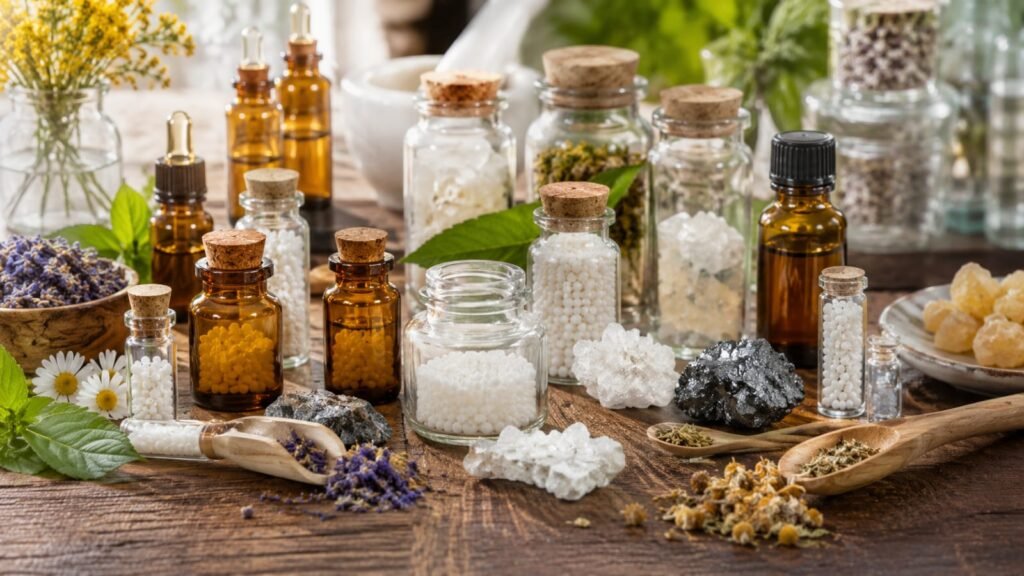
One of the most common misconceptions about homeopathy is that all remedies come from herbs or plants. In reality, homeopathic remedies can be prepared from a wide range of natural substances. These may include plants, minerals, metals, naturally occurring compounds, and other substances that have been studied within homeopathic practice over time. Many well-known remedies originate from flowers, roots, tree bark, mineral compounds, or naturally occurring substances found in nature. Each remedy begins with a carefully selected source material that has a documented history within the homeopathic tradition. Before a remedy reaches a patient, it goes through a series of preparation steps that transform the original substance into the final product found on pharmacy shelves.
The First Step: Creating the Mother Tincture

The preparation process usually begins with what homeopaths call a mother tincture. A mother tincture is the original extract made from the source substance. For plant-based remedies, this often involves extracting components from the plant using a mixture of alcohol and purified water. In many respects, this stage resembles the preparation of herbal extracts used in herbal medicine. At this point, the original substance is still present in measurable quantities. The mother tincture serves as the foundation from which different homeopathic potencies are created.
The Process That Makes Homeopathy Different

Once the mother tincture has been prepared, homeopathy takes a very different path from conventional medicine or herbal medicine. The next stage is called potentization. Potentization involves a series of carefully controlled dilutions. After each dilution step, the preparation is vigorously shaken. This shaking process is known as succussion.
The method was developed by the German physician Samuel Hahnemann in the late 18th century. Hahnemann believed that remedies could be prepared in a way that reduced unwanted effects while preserving their therapeutic qualities. Over time, potentization became one of the defining principles of homeopathic pharmacy. Today, manufacturers follow standardized procedures to ensure consistency throughout the preparation process.
Understanding Potencies
If you’ve ever seen a homeopathic remedy labeled 6C, 30C, or 200C, you’re looking at its potency. The number indicates how many times the dilution and succussion process has been repeated.
| Potency | Description |
| 6C | 6 dilution steps |
| 30C | 30 dilution steps |
| 200C | 200 dilution steps |
| 1M | 1,000 dilution steps |
The “C” scale is one of the most commonly used potency systems in homeopathy. A 30C remedy, for example, has gone through thirty sequential dilution and succussion stages according to homeopathic pharmaceutical standards. Different practitioners may choose different potencies depending on the individual’s symptoms, health history, and clinical approach.
Is There Any Medicine Left in Highly Diluted Remedies?
This is probably the most frequently asked question about homeopathy. As potencies increase, the amount of original source material becomes progressively smaller. At higher potencies, the dilution may be so extensive that little or none of the original substance can typically be detected using conventional laboratory methods. This fact lies at the center of the debate surrounding homeopathy. Critics argue that if the original substance can no longer be detected, the remedy should not be expected to produce biological effects beyond placebo. Supporters of homeopathy view the situation differently.
Over the years, various hypotheses have been proposed to explain how highly diluted remedies might exert effects. Some researchers have explored whether the potentization process leaves measurable changes in the structure or properties of the preparation. Others have investigated whether nanoparticles of the original substance may remain in certain remedies despite extensive dilution. Additional theories suggest that information or patterns associated with the original substance may somehow be retained during the preparation process. At present, no single explanation has achieved universal scientific acceptance, and research in this area continues. Regardless of where one stands on the debate, the question remains one of the most discussed and actively studied aspects of homeopathy.
Is Homeopathy “Real”?
The answer depends on what someone means by the question. Homeopathy is certainly real in the sense that it is a medical system that has existed for more than two centuries, is practiced in many countries, and involves standardized methods of remedy preparation. The larger debate concerns efficacy and mechanism. Supporters point to clinical experience, patient reports, and research they believe supports homeopathic treatment. Critics argue that evidence for effectiveness beyond placebo remains insufficient and that proposed mechanisms are difficult to reconcile with current scientific understanding. As a result, homeopathy remains both widely used and widely debated.
Are Homeopathic Remedies Safe?
Safety is another common question. Homeopathic remedies manufactured by licensed producers are generally prepared according to established pharmaceutical standards and regulatory requirements that vary by country. One reason homeopathy developed its dilution process was Hahnemann’s desire to reduce the unwanted effects he observed with some medical treatments of his time. As with any healthcare product, patients should follow labeling instructions and consult qualified healthcare professionals when appropriate, particularly for serious medical conditions or when using multiple treatments.
Are Homeopathic Remedies Regulated?
Yes, in many parts of the world they are. The exact regulatory framework varies by country, but homeopathic remedies are commonly manufactured under established quality-control procedures. Manufacturers typically follow detailed standards covering:
- Raw material sourcing
- Production procedures
- Potentization methods
- Packaging
- Labeling
- Storage
- Quality assurance
Many countries also maintain official pharmacopoeias that outline standards for homeopathic medicine production. These systems help ensure consistency and manufacturing quality across producers.
How Is Homeopathy Different From Herbal Medicine?
People often confuse homeopathy with herbal medicine because both may begin with plant-based ingredients. However, they are fundamentally different systems. Herbal medicine generally relies on measurable amounts of active compounds naturally present in a plant. The goal is often to utilize those constituents directly. Homeopathy, by contrast, uses the process of potentization. The remedy is prepared through sequential dilution and succussion, and the final product may contain only very small amounts, or in some cases no detectable amounts, of the original source material. While both approaches may use natural starting materials, the philosophy, preparation methods, and theories behind them are quite different.
Curious About How Homeopathic Remedies Are Chosen?
A remedy is only one part of the homeopathic process. During a consultation, practitioners look beyond a diagnosis and consider the individual’s unique symptoms, health history, and overall wellbeing when selecting a remedy. Visit www.homeo-path.com/find/ to book a practitioner.