Decoding Homeopathic Credentials: What Do All Those Letters Mean?
Choosing a homeopath can be confusing. Practitioner profiles often include initials such as BHMS, MD (Hom), CCH, LFHom, RSHom, DHANP, and many others. While these credentials can provide insight into a practitioner’s education and training, they are not all equivalent.
Unlike conventional medicine, there is no single international standard for homeopathic education. Some countries regulate homeopathy through universities and national healthcare systems, while others rely on private colleges, professional organizations, or certification boards.
This guide explains the most common homeopathic credentials, what they require, and how they compare.
Quick Comparison
| Credential | Country | Entry Requirement | Typical Length | Clinical Training |
|---|---|---|---|---|
| BHMS | India | High school (Physics, Chemistry, Biology) + entrance exam | 5.5 years | 1-year supervised internship |
| MD (Hom) | India | BHMS | 3 years | Advanced clinical training and research |
| DHMS | India (legacy) | High school | 4 years | Supervised clinical training |
| CCH | United States | Approved homeopathic education | Varies (typically 2–4 years part-time) | Supervised cases required |
| LFHom | UK | Licensed healthcare professional | 1–3 years part-time | Supervised postgraduate training |
| MFHom | UK | LFHom plus experience | Varies | Advanced assessment |
| FFHom | UK | Senior professional recognition | Varies | Based on contribution to the profession |
| RSHom | UK | Approved homeopathic education | Usually 3–4 years | Clinical hours required |
| DHANP | United States | Licensed naturopathic doctor | Postgraduate | Advanced homeopathic training |
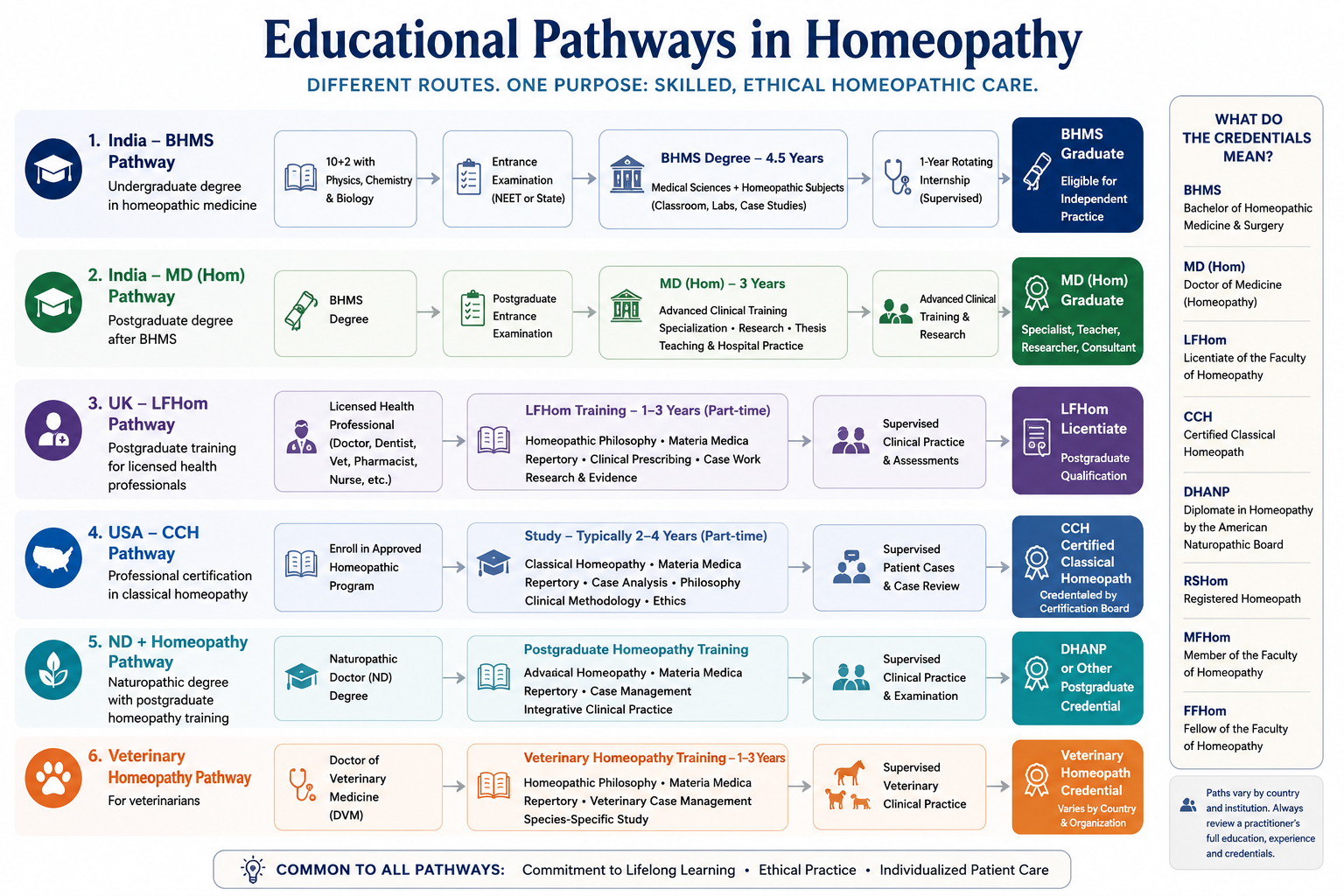
India
India has the world’s largest and most standardized system of homeopathic education. Homeopathy is officially recognized within the country’s healthcare system, and most practitioners complete university degrees before entering practice.
BHMS — Bachelor of Homeopathic Medicine and Surgery
Country: India
Entry requirements: Completion of higher secondary education with Physics, Chemistry, and Biology, followed by a competitive entrance examination (typically NEET).
Length: 5½ years.
Coursework:
- Human anatomy
- Physiology
- Biochemistry
- Pathology
- Microbiology
- Pharmacology
- Forensic medicine
- Community medicine
- Surgery
- Obstetrics & gynecology
- Organon of Medicine
- Materia Medica
- Repertory
- Homeopathic pharmacy
- Clinical homeopathy
- Case-taking and analysis
Clinical training: A mandatory one-year rotating internship in hospitals and outpatient clinics under supervision.
Awarded by: Universities recognized by India’s homeopathic education authorities.
BHMS is one of the most comprehensive undergraduate homeopathic qualifications in the world. Graduates receive extensive training in both biomedical sciences and classical homeopathy before beginning independent practice.
MD (Hom) — Doctor of Medicine (Homeopathy)
Country: India
Entry requirements: BHMS degree and postgraduate entrance examination.
Length: 3 years.
Coursework:
- Advanced Organon
- Advanced Materia Medica
- Advanced Repertory
- Research methodology
- Clinical specialization
- Medical statistics
- Dissertation or thesis
Clinical training: Advanced supervised clinical practice combined with research and teaching responsibilities.
Awarded by: Universities.
Despite the name, an MD (Hom) is a postgraduate degree in homeopathy rather than the conventional medical MD awarded in countries such as the United States or Canada.
DHMS — Diploma in Homeopathic Medicine and Surgery
The DHMS was a four-year diploma offered in India before the BHMS became the national standard. Many experienced practitioners still hold this qualification, although it has largely been phased out for new students.
United Kingdom
The UK has a long history of homeopathy, but educational pathways vary depending on whether a practitioner is already a licensed healthcare professional.
LFHom — Licentiate of the Faculty of Homeopathy
Entry requirements: Licensed physician, dentist, veterinarian, pharmacist, nurse, or another regulated healthcare professional.
Length: Usually 1–3 years part-time.
Coursework:
- Homeopathic philosophy
- Materia Medica
- Repertory
- Clinical prescribing
- Case analysis
- Evidence and research
Clinical training: Supervised postgraduate clinical practice and formal assessments.
Awarded by: The Faculty of Homeopathy.
LFHom is an additional qualification rather than an entry-level degree. It builds on an existing healthcare profession.
MFHom — Member of the Faculty of Homeopathy
MFHom is an advanced postgraduate qualification awarded after additional examinations, clinical experience, and continued professional development. It demonstrates a higher level of expertise than LFHom.
FFHom — Fellow of the Faculty of Homeopathy
FFHom is the Faculty’s highest professional distinction. It recognizes experienced practitioners who have made significant contributions through clinical practice, education, leadership, or research.
RSHom — Registered Homeopath
Entry requirements: Graduation from an approved homeopathic training program.
Length: Usually 3–4 years, depending on the school.
Coursework:
- Organon
- Materia Medica
- Repertory
- Case-taking
- Clinical homeopathy
- Professional ethics
Clinical training: Supervised clinical practice and completion of required clinic hours.
Awarded by: Professional registration organizations.
Because educational programs differ, practitioners holding the RSHom designation may have completed different curricula.
United States
Homeopathy is not regulated nationally in the United States, so educational pathways vary considerably.
Some practitioners are physicians, naturopathic doctors, chiropractors, dentists, veterinarians, or nurses who later receive postgraduate homeopathic training. Others complete dedicated homeopathic programs without first qualifying in another healthcare profession.
CCH — Certified Classical Homeopath
Entry requirements: Completion of approved homeopathic education and eligibility to sit for a national certification examination.
Length: Varies by school, typically 2–4 years of part-time study.
Coursework:
- Classical homeopathic philosophy
- Organon
- Materia Medica
- Repertory
- Case analysis
- Ethics
- Clinical methodology
Clinical training: Supervised patient cases, case reviews, and competency examinations. Mentorship requirements vary between educational programs.
Awarded by: An independent certification board.
Unlike a university degree, the CCH is a professional certification that confirms competency in classical homeopathy.
DHANP
Entry requirements: Licensed naturopathic doctor.
Length: Postgraduate.
Coursework:
- Advanced homeopathic prescribing
- Complex case management
- Materia Medica
- Repertory
- Integrative clinical care
Clinical training: Supervised postgraduate clinical experience and examination.
DHANP represents advanced homeopathic training completed after earning a naturopathic medical degree.
Canada
Canadian practitioners may hold credentials from professional colleges or graduate from Canadian or international homeopathic schools.
CCHM
The Certified Classical Homeopath (Canada) designation is awarded after completing approved education, clinical training, and certification requirements. Programs generally include several years of part-time study in classical homeopathy, supervised clinical cases, and examinations.
Europe
Educational standards vary widely across Europe.
Countries such as Germany, France, Spain, Italy, Belgium, and Switzerland may offer homeopathic education through medical associations, postgraduate physician training, universities, or private colleges depending on local regulations.
Because requirements differ substantially, patients should review each practitioner’s educational background rather than relying solely on the credential itself.
Other Common Credentials
DSH
Usually stands for Diploma in the Science of Homeopathy. Awarded by private colleges or professional organizations. Programs typically last 2–4 years part-time and include philosophy, Materia Medica, repertory, and supervised clinical work.
PCH
Professional Certified Homeopath is another certification used by some organizations. Requirements generally include formal education, supervised cases, and examinations.
HD
Some practitioners use Homeopathic Doctor (HD) as a professional designation. Because this title is not standardized internationally, patients should review the practitioner’s underlying education to understand what it represents.
Credentials Matter—But They Aren’t Everything
A credential tells you how a practitioner was educated. It does not necessarily predict clinical skill or patient experience.
When choosing a homeopath, consider the complete picture:
- Education and qualifications
- Years in practice
- Clinical experience with your concerns
- Continuing education
- Professional registration
- Patient reviews and testimonials
- Communication style
- Whether you feel listened to and understood
Many excellent practitioners hold different credentials because they trained in different countries. Understanding what those credentials represent allows you to compare practitioners more confidently and choose someone whose education and experience best match your needs.